Common misconceptions about aviation and Malmi Airport
 |
On this page you'll find the most common misconceptions about aviation and Malmi Airport. Do you think that one of the statements below is true? Click on it and be surprised!
Misconception 1: Aviation is a show-off hobby for rich people only.
Misconception 2: At Malmi, there are just hobbyists making noise for fun.
Misconception 3: There's no reason why Malmi's operations couldn't be moved 65 miles away.
Misconception 4: There aren't any general aviation airports in the middle of the city anywhere else.
Misconception 5: Two airports so close to each other are a safety risk.
Misconception 6: There's nothing worth preserving in Malmi Airport.
Misconception 7: Aviation is extreme sports suitable only for supermen and -women.
Misconception 8: Malmi Airport must go because Helsinki needs building ground for residential areas.
Misconception 9: Malmi Airport disturbs the people living nearby.
Misconception 10: Malmi Airport disturbs the nature.
Misconception 11: Malmi Airport is a dead place where nothing ever happens.
Misconception 12: The traffic at Malmi Airport has diminished to half of the 1990 level, so there is clearly no more demand for it.
Misconception 13: The ancient flying wrecks of Malmi Airport are a safety hazard to the people living nearby.
Misconception 14: A new residential area on Malmi Airport is crucial to the future and the services of the region.
Misconception 15: Malmi Airport is maintained by large sums of taxpayers' money.
Misconception 16: The operations of Malmi Airport cannot be developed at the present location.
Misconception 1: Aviation is a show-off hobby for rich people only.
Truth: Aviation is within the grasp of any person of the capital region with an average salary, and the large band of aviation hobbyists at Malmi consists of perfectly ordinary people from all walks of life. While the expenses of a professional pilot's education are high, a private pilot's license or an ultralight pilot's license obtained from courses arranged by aviation clubs will not ruin anyone's economy. If you can afford e.g. motorcycling, you could just as well be flying.
An undeniable proof of this are the students of Helsinki University of Technology, who in their aviation club train pilots and fly year-round, even though they can't possibly be considered to make even an average income.
If you are not interested in powered flight, parachuting is even less expensive. There is no other place in the capital region where parachuting is possible. Model plane enthusiasts also enjoy flying their racers at Malmi Airport, and a huge crowd of people from the capital region simply likes to watch the propeller aircraft operating there. This doesn't cost a penny, and the viewing platform and restaurant at Malmi offer a perfect place for it for the whole family. The aviation events organized at Malmi Airport regularly bring around tens of thousands of people.
 |
| A typical view of the parking lot (2001). Cars of rich people? Count the Mercs! |
Misconception 2: At Malmi, there are just hobbyists making noise for fun.
Truth: The hobbyists' share of Malmi's activities is less than 20%. Malmi is an international airport complete with passport control and a Customs office, serving domestic and international light traffic. It is also an important base of the Frontier Guard, the Police traffic monitoring helicopter and has also been used by the SAR rescue helicopter and the Medi-Heli ambulance helicopter.
Even in the field of hobby aviation voluntary work is done for the public good, e.g. SAR flights (Search and Rescue) as well as surveillance flights targeted against illegal spills from ships in the Gulf of Finland as part of WWF Finland's Baltic Sea campaign (Operation Flying Mermaid).
Above all, Malmi is by far the biggest aviation education center in the country. Training flights form a majority of all traffic at the Airport. In addition to the private pilots of the capital region, 2/3 of all professional pilots get their education there, then serving the aviation trade as airline pilots. Because of its great location, the Airport is such a crucial center of aviation education and recruiting that the Civil Aviation Administration, taking care of Finnish aviation's prerequisites and needs, has willingly maintained it even at a net loss.
Misconception 3: There's no reason why Malmi's operations couldn't be moved 65 miles away.
Truth: Malmi Airport is the lifeline of general aviation in the capital region simply because of its excellent location. A short distance to travel to the airport makes it possible for the aviation clubs to overhaul and maintain their aircraft to a large extent by voluntary work, without the need to buy these services from commercial entrepreneurs except in the case of the most demanding jobs. This in turn keeps the price of flying within the reach of an average aviator. The youths of the capital region also have a chance to get to enjoy aviation incentives by local bus or bike.
A trip to e.g. Kiikala, offered as a "replacement" site (100 km / 65 miles away), will take an hour even by car, let alone by coach. If the aviation operations of Malmi are moved to such a distance from the capital, the price of flying and the time required to reach the airfield will increase to an unbearable level. Because of these new unreasonable requirements, no new hobbyists would be obtained from the capital region, and a whole branch of trade and human activity would wither away from the most densely populated region of the country.
For taxi flights, the situation 100 km away would be just as bizarre. A taxi stand 65 miles away does not serve a customer in Helsinki in any way. As a replacement site for Malmi, Kiikala was rejected due to its excessive distance by the so-called Piirainen expert group, appointed by the Ministry of Traffic and Communications, as early as 2000.
When the present effort to shut down Malmi Airport was being started at the end of the 20th century, a "replacement" airfield in Sipoo right next to the capital was strongly hinted at. After that, the "replacement" airfield location has moved bit by bit further away, via Mäntsälä to Riihimäki to Kiikala 65 miles away, where it doesn't have anything to do with the general aviation needs of the capital region any more. Consequently, the plan to build a completely new "replacement" airfield has been abandoned.
The decentralization of Malmi's aviation activities to existing small airfields (e.g., Nummela, Räyskälä, Vesivehmaa, Kiikala) has also been proposed. In part for the same reasons as above, these rural airfields do not have the capacity to sustain the aviation activities of the capital region. The firms operating on Malmi Airport have almost without exception declared that they have no economic future whatsoever on any airfield further away from the capital. The simple reason for this is the lack of a customer base. In decentralizing Malmi's operations, the excellent synergy between various aviation-related sectors would also be lost.
After relocating the activities of Malmi Airport, Helsinki would be one of the few European capitals without access by small aircraft - just at the time when the Baltic states are opening doors towards Europe. For the sake of comparison, it is worthwhile to note that in Stockholm, Sweden, the regional runway capacity was in 2003 seen as such a regional advantage that downsizing it was not considered affordable. In addition to Arlanda Airport, Stockholm is served by three airfields comparable to Malmi and several smaller ones within a 25 km radius of the city.
Misconception 4: There aren't any general aviation airports in the middle of the city anywhere else.
Truth: Malmi Airport is not in the middle of Helsinki, but at the furthest limit northeast about 10 km from the city center. There are general aviation airfields much closer to notable cities in Europe and around the world. The table below shows examples of general aviation airfields serving light traffic in cities around the world.
City           Main airport (distance)           General aviation airfield (distance)

Adelaide       Adelaide International (6 km)     Parafield (15 km)
Amsterdam      Schiphol (9 km)                   Hilversum (24 km)
Auckland       Auckland International (17 km)    Ardmore (27 km)
Belfast        Aldergrove (21 km)                Belfast City (2 km)
Berlin         Tegel (8 km)                      Werneuchen (15 km)
Bonn           Konrad Adenauer (20 km)           Hangelar (6 km)
Brussels       Bruxelles National (7 km)         Grimbergen (12 km)
Bukarest       Otopeni (17 km)                   Banesa (9 km)
Calgary        Calgary International (8 km)      Springbank (22 km)
Dublin         Dublin International (10 km)      Weston (12 km)
Düsseldorf     Düsseldorf International (7 km)   Mönchengladbach (20 km)
Gothenburg     Landvetter (20 km)                Gothenburg City / Säve (9 km)
Hamburg        Hamburg (9 km)                    Finkenwerde (10 km)
Helsinki       Vantaa (17 km)                    Malmi (10 km)
Copenhagen     Kastrup (6 km)                    Roskilde (27 km)
London         Heathrow (22 km)                  London City (11 km)
Lyon           St. Exupéry (11 km)               Bron (12 km)
Madrid         Barajas (13 km)                   Cuatro Vientos (9 km)
Malmö          Sturup (24 km)                    Lund (17 km)
Melbourne      Melbourne (22 km)                 Moorabbin (22 km)
Milan          Maipensa (40 km)                  Linate (6 km)
Munich         Munich International (28 km)      Oberschleissheim (8 km)
Oslo           Gardemoen (50 km)                 Kjeller (20 km)
Paris          Charles de Gaulle (25 km)         Le Bourget (12 km)
Perth          Perth International (10 km)       Jandakot (16 km)
Reykjavik      Reykjavik (35 km)                 Reykjavik City (1 km)
Sydney         Kingsford Smith Int'l (9 km)      Bankstown (21 km)
Toronto        Pearson International (20 km)     Billy Bishop (3 km)
Stockholm      Arlanda (37 km)                   Bromma (7 km)
Warsaw         Okecie (10 km)                    Babice (10 km)
Vancouver      Vancouver (12 km)                 Boundary Bay (16 km)
Vienna         Wien (16 km)                      Stockerau (22 km)
Zurich         Kloten (9 km)                     Birrfeld (12 km)
It is worthwhile to think how "Helsinki-Kiikala, 100 km" would look in place of Malmi on this list of European cities. This notion reveals the big problem with the proposed "replacement airfields" of Malmi: they do not replace Malmi on any level because they do not serve the aviation needs of the capital region.
In addition, it must be taken into account that by far the majority of all airports in Finland are less than 20 km away from a city and serve general aviation too. The million-people capital region ending up as the leading aviation backwater in the country and in Europe would be quite harmful to the aspirations of Helsinki to become a European metropolis.
Misconception 5: Two airports so close to each other are a safety risk.
Truth: The airspaces of Helsinki-Vantaa ja Helsinki-Malmi are completely separate and have their own air traffic controls. Malmi tower is subordinated to Vantaa tower. The airspace borders are very clear and tightly controlled. In this way the problems caused by fast heavy jets and slow small aircraft operating in the same lively airspace are avoided.
This system works and has worked splendidly for decades: Helsinki-Vantaa takes care of heavy fast traffic, and Malmi serves slow small aircraft completely separately. Flight safety is thus maintained in the best possible way. The airports in Vantaa and at Malmi can arguably be seen as a single metropolitan airport where the runways serving different kinds of traffic have been separated from each other.
If Malmi Airport were closed down, light air traffic at Helsinki-Vantaa would unavoidably increase because part of, e.g., chartered light traffic would land there due to the excessively long distance of the airfield "replacing" Malmi. Taking the long-term air traffic forecasts into account, if Helsinki-Vantaa were to remain the sole airfield in the capital region, the smooth operation of air traffic would certainly be hampered.
Misconception 6: There's nothing worth preserving in Malmi Airport.
Truth: Malmi is one of the best-preserved pre-WWII international airport milieus in the world. The functionalist architecture of its buildings has won international acclaim. Since 1991, the Airport as a whole has been included in the list of nationally significant cultural environments (in Finnish) by the National Board of Antiquities (NBA) and the Ministry of the Environment. The Airport has also been included on the global List of 100 Most Endangered Sites by World Monuments Fund (WMF). According to both the NBA and the WMF, the cultural-historical value of the Airport is strongly based on its continuing busy aviation use. The Airport with its runways has also been included in the selection of significant monuments of modern architecture by the international DoCoMoMo working group.
The function of the buildings as a part of an operational airport would be lost if the aviation activities were relocated and a suburb were built on the runways. The most significant historic aviation milieu in Finland and its cultural value would be destroyed, and only two buildings torn from their functional purpose would remain. As such, the remains of Malmi Airport would have no claim to be included in any international lists of valuable sites.
As a consequence of its numerous international recognitions and cultural-historical monument listings, Malmi Airport has become a significant case for Finland's reputation as a nation of culture. As a Member State of UNESCO, Finland has in October 2003 signed the UNESCO Declaration Concerning Intentional Destruction of Cultural Heritage. This Declaration is a moral obligation to act in protection of cultural heritage against intentional destruction by, e.g., defining legal consequences on state and individual level.
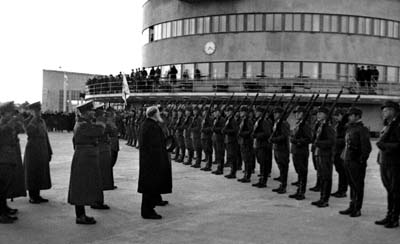 |
| President Kallio departing from Malmi to Stockholm to plead for western help for Finland in October 1939. |
Malmi Airport has been the stage of numerous important occasions in the history of independent Finland since the latter part of the 1930's. From there, statesmen and ministers have departed to official visits and important negotiations in a time when the World War was falling on a small nation. The scheduled Ju-52 airliner "Kaleva" of Aero o/y was on its way to Malmi from Tallinn when it was shot down by the Soviet Air Force. The Allied Control Commission arrived at Malmi Airport after the armistice in September 1944. The coffin of Finland's Marshal Mannerheim was brought to Malmi from Switzerland, and Miss Universe Armi Kuusela left to conquer the world from Malmi in 1952. These are just a small glimpse at all the significant events that have taken place at Malmi Airport. Guess where 19-year-old Cessna 172 pilot Mathias Rust took off on his world-famous flight to Moscow's Red Square on 28 May 1987?
All the events that have taken place at Malmi over the decades form an invaluable, unbroken aviation tradition which is alive in a completely different way than just on the pages of history books.
Misconception 7: Aviation is extreme sports suitable only for supermen and -women.
 |
| Yippeeee! |
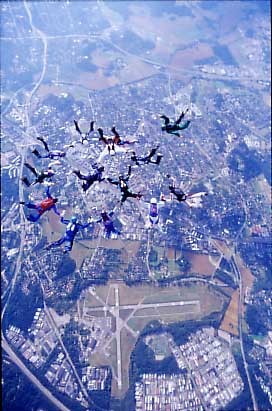
Truth: This notion, kept up by movies and TV entertainment, is simply not true. Small-aircraft aviation is not an extreme sport at all. It is extremely safe, and suitable for any person of normal health. Typical eye-glasses or overweight are no obstacle to obtaining a pilot's license. Parachuting is more of an extreme sport, but it doesn't require superhuman qualities either - if you have no fears about bungee jumping, parachuting will not pose a problem.
Misconception 8: Malmi Airport must go because Helsinki needs building ground for residential areas.
Truth: The present unrealized housing construction projects cover the requirements of the baseline scenario until 2050. The population forecast of Helsinki region 2014-2050 (City of Helsinki, Statistics 29/2013, tables on pages 41-42) predicts that the population of Helsinki will then be 750 000 people instead of the present 604 000. The population growth estimate is thus 146 000.
By adding up the recently begun or soon-to-begin housing area projects' planned numbers of residents (see Helsinki City Planning Department, situation in April 2014, a more complete list is on the Finnish page), the following result is obtained:
Östersundom:          58000-64000 people
Kalasatama:           20000 people
Jätkäsaari:           16000 people
Pasila:               11400 people
Kruunuvuorenranta:    11000 people
Vartiosaari:           5000-7000 people
Kuninkaantammi:        6600 people
Hernesaari:            5100 people
Koivusaari:            4000 people
Myllypuro:             3000 people
Hakuninmaa:             800 people
Telakkaranta:           400 people
______________________________________
Total                141300-149300
This calculation does not include the complementary building reserve in Helsinki or the unfinished area projects for which the number of residents-to-be is not specified on the City Planning Department's pages.
The latest development in increasing the building land reserve of Helsinki is the annexation of southwest Sipoo (Östersundom) to Helsinki in 2009. The planning area of Östersundom is 21 times as large as Malmi Airport and its safety zone. This was made possible by creating a common border between Helsinki and Sipoo by the annexation from City of Vantaa of the so-called Västerkulla Triangle, which is by itself the same size as Malmi Airport and its safety zone. The planning area of Östersundom has an area of 45 km square, of which protected Natura regions and their exclusion areas take away about 9 km square according to the latest information (2013). The remaining 36 km square of usable land is equal to more than seventeen Malmi Airports and their safety zones.
Outside Helsinki city limits, in the other municipalities of the capital region, there is more than enough high-quality building ground for planning for all future needs, if only cooperation in making use of them is achieved over the municipality borders on the map. A metropolitan administration over the borders and the consolidation of municipalities are constantly debated as urgently needed measures to make the building politics of the capital region more rational, and the State is vigorously promoting them. It is thus to be expected that in the near future, long before the year 2050, the ample building land reserve of the capital region becomes available to housing production in a rational manner.
Because of this, the hurried destruction of remaining diversity of cultural environments and landscapes inside the borders of Helsinki is perverse, especially in the case of Malmi Airport: with its air traffic control and international point-of-entry services Malmi Airport is, in addition to Lappeenranta, the only airport offering a full palette of services to light aircraft in all of Southern Finland Province. The nearest airport with a comparable level of service is in Turku some 150 km away. Helsinki-Vantaa International Airport, focusing on heavy scheduled air traffic, only serves light aircraft in a very limited manner.
Thus the closing down of Malmi Airport to build an apartment house area for 20000-30000 people simply cannot be a matter of life and death for Helsinki. The choking of the operations of a functionally irreplaceable airport as a target for housing construction, going on for decades already, does not serve the general interests of society nor the building of a European metropolis.
Misconception 9: Malmi Airport disturbs the people living nearby.
Truth: Every time a poll is made concerning this matter, the noise-protesters are left in a small minority. The web and SMS poll of the city newspaper "Uutislehti 100" on 24 November 2005 was open to everyone who wished to participate. 94% of them were in favor of preserving the Airport instead of building a suburb in its place. A 90.9% vote in favor of preserving the Airport was obtained by the local newspaper "Helsingin Uutiset" on 12 January 2003. To an overwhelming majority of the local residents, the beautiful airport and its special historic and cultural character are a matter of pride. In addition, the Airport has operated continuously for almost 70 years, long before any of the suburbs now surrounding it were built. Thus it is difficult to imagine that the sounds of flying would have come as a surprise to those who moved into the vicinity.
Several local residents' associations and other associations have voiced their support for preserving Malmi Airport in aviation use. The petition of the Friends of Malmi Airport Society to save Malmi Airport has been signed by thousands of people living nearby.
The opinion of all the people of Helsinki was made clear by Gallup Finland in October 2004. In this professional, unbiased opinion poll with an error margin of 3%, it was shown that 58% of the people of Helsinki (more than 320.000 people) is in favor of keeping Malmi Airport in aviation use. Only 22% of the people wanted the Airport to be used for residential purposes. Gallup Finland made a similar study in December 2005 for the whole capital region (Helsinki, Espoo and Vantaa), and the preservation of the Airport got a 65% support (equal to more than 630.000 capital region residents). According to the recent study by TNS Gallup in February 2011, 56% of the people of Helsinki want to keep Malmi Airport in aviation use.
The latest information about the alleged disturbance caused by Malmi Airport can be found in the City of Helsinki Environment Centre's questionnaire study, published in 2010 (in Finnish, summary in English on page 4), where 2100 randomly selected residents described the quiet places that they find important in the capital. Malmi Airport emerged as a place whose almost perfect tranquility in the evenings, at night and in winter is perceived as worth mentioning.
Misconception 10: Malmi Airport disturbs the nature.
 |
| My kind nests at Malmi Airport - and nowhere else in Helsinki! (Photo: Timo Yli-Viikari, taken elsewhere) |
Truth: Malmi Airport is one of the most significant bird paradises in Helsinki. Species that are seldom seen in the capital nest there regularly (e.g. the curlew, Numenius arquata). Several species mentioned in Appendix 1 of the European Union's Bird Directive reside at the Airport. The corncrake (Crex crex), the whinchat (Saxicola rubetra), the common whitethroat (Sylvia communis) and the red-backed shrike (Lanius collurio), all with a near-threatened status in the international IUCN classification, nest there.
The Airport also has a plentiful population of small mammals, foxes and brown hares, as well as a rich ecosystem of insects and plants. Almost 70 years of uninterrupted aviation activity has not bothered them. The Finnish Association for Nature Conservation has in several statements opposed the relocation of Malmi's aviation operations. The same view has been presented by the local MaTaPuPu Birding Society.
The nature path encircling the Airport is hugely popular among the local residents because Malmi Airport is the last remaining open green area in their home district. More information about the nature values of Malmi Airport can be found on the pages of MaTaPuPu Birding Society (in Finnish only).
The natural diversity of the Airport cannot be expected to survive a huge construction site and 10.000 new residents.
Misconception 11: Malmi Airport is a dead place where nothing ever happens.
Truth: When measured by take-offs and landings, Malmi Airport is by far the second liveliest airport in Finland after Helsinki-Vantaa International Airport. This can be confirmed from the Annual Report of Finavia 2013 (page 103).
Malmi Airport serves the general aviation needs of the whole capital region and is for almost a million people the only place where versatile aviation activities are available at reasonable cost and trouble (and using local public transportation). The Airport also frequently serves as a venue of public events not related to aviation, e.g. concerts and motor sports events.
Misconception 12: The traffic at Malmi Airport has diminished to half of the 1990 level, so there is clearly no more demand for it.
Truth: By looking at the number of landings at Malmi Airport from 1980 onwards it is easy to see that the huge traffic in the reference year 1990 is a consequence of the anomalously overheated economy of that time, and the downhill afterwards reflects the great economic depression of the 1990's. The basic traffic at Malmi Airport has been stable over a long period of time - and it is by far the busiest in Finland after Helsinki-Vantaa International Airport.
 |
Misconception 13: The ancient flying wrecks of Malmi Airport are a safety hazard to the people living nearby.
Truth: All aircraft must meet extremely tight maintenance requirements that are rigorously enforced. Safety is the leading principle in all aviation. Every small aircraft must be inspected annually and undergoes meticulously defined maintenance procedures at specified time intervals (e.g., 50 hours, 100 hours, 200 hours). Without these overhauls, the aircraft is grounded.
This is why the aircraft are technically extremely reliable regardless of their age and looks. Just in case, the Airport is surrounded by open safety zones where the aircraft can land in an unlikely forced landing situation. Throughout the 70-year-long history of Malmi Airport, no bystanders near the Airport have been injured or killed by an aircraft.
Misconception 14: A new residential area on Malmi Airport is crucial to the future and the services of the region.
Truth: Malmi Airport is no threat to the services in the region. The business center of Malmi has a solid, large and faithful customer base which has no interest in regular shopping at other similar centers further away.
As to the future of the region, much greater prospects are offered by the sole general aviation airport in the metropolitan area - an international channel of light air traffic which at the same time is a recognized world-class cultural rarity.
Taking the long-term air traffic forecasts into account, giving up such a regional advantage and potential business magnet just to cram one more suburb into a densely populated area would be senseless. It is worthwhile to note that the Northeast Helsinki Entrepreneurs' Association is a member organization of the Friends of Malmi Airport Society.
In light of all the international recognition, Malmi Airport has all the makings of a UNESCO World Heritage Site. Complemented by a high-quality aviation museum the Airport can be developed into a world-class attraction for cultural tourism, bringing considerable income and international appreciation to the region.
Misconception 15: Malmi Airport is maintained by large sums of taxpayers' money.
Truth: The maintenance of the airport system in Finland is payed for by the users of the Airports, not the taxpayers. Finavia is a government-owned enterprise which finances the upkeep of the aviation infrastructure from its revenues. Finavia chooses to keep Malmi Airport operational even at a net loss. This is an indication of the value of Malmi Airport as an education and recruiting center as perceived by the foremost expert organization in the field of aviation.
According to Finavia, the net costs of Malmi Airport are about 750.000 euro annually. This sum is collected from the passengers using Finavia's airports and comes to about six eurocents per flight ticket. On the other hand, the professional pilot education infrastructure elsewhere in Finland is supported with tax money from the Ministry of Education and Culture by several million euro per year. In spite of this, it is Malmi that produces 2/3 of all professional pilots in Finland. Thus, from the point of view of the taxpayers, Malmi Airport is by far the most efficient pilot training center in the country.
It is said that the City of Helsinki loses land rent and tax income because of Malmi Airport. This argument, however, is never presented when talking about the large unbuilt land areas, suitable for housing, which the City could afford to leave completely outside the City Plan 2002 and which have not been ceded to any other purpose. Because of this, the claims of the City's loss of income are not convincing in the least.
Misconception 16: The operations of Malmi Airport cannot be developed at the present location.
Truth: In the United States, the aviation authorities have already in 2006 warned U.S. cities against closing down their small regional airports. The revolution which is in progress in the field of business aircraft will in the near future make such airports important regional assets.
In a couple of decades, every runway in the capital region will be indispensable. According to the commercial aviation growth estimates of EUROCONTROL, the European Organisation for the Safety of Air Navigation, air traffic in Finland and neighboring countries will double from the 2005 level by 2025. In that event, the smooth and flexible operation of business flights at Helsinki-Vantaa International Airport would be in jeopardy; the non-scheduled business flights can get flexible service only when the regular scheduled air traffic situation allows it.
 |
| The European GPS-augmenting EGNOS system is already operational as an open service. With EGNOS, a positional accuracy equal to or better than ILS category I, a prerequisite for commercial flight operations, can be achieved without any expensive installations of equipment on the airport. EGNOS is fully compatible with the American WAAS, which has for several years been in aviation use in the United States. The safety-of-life level EGNOS service was announced operational in March 2011, and its successor Galileo (operational in 2014) and its augmenting services will take the positional accuracy of navigation to the level that makes automated landings possible. The traditional ILS, stemming from the 1940's, is coming to the end of its service life. |
The new generation of small 4-8 seat microjets (VLJ, Very Light Jet) cause less noise than the traditional propeller aircraft at Malmi Airport. They are in practice as fast as traditional business jets, considerably less expensive to buy and to maintain, and they can operate without difficulty from just 1-km-long runways. They are taking the business aviation market by storm everywhere in the world, and some have already been ordered to Finland too. As this new generation of business aircraft takes over, the present runways at Malmi Airport will be fully adequate to ensure the flexible business flight services of the capital region.
The flexibility of business flight services will also be lost if the airport serving them is located e.g. at the distance of Porvoo from the capital region. Potentates of international business and politics, arriving on a 1-hour flight from Stockholm, St. Petersburg, the Baltic countries or other nearby airfields, will not spend more than an hour on the road in the morning rush hour traffic towards Helsinki, and back to the airport in the evening. Malmi Airport is located in an excellent place just 15 minutes away from the city centers of the capital region and from Helsinki-Vantaa International Airport, and it also makes the dozens of small airfields around Finland easily accessible.
It is quite possible to devise an instrument landing method on Malmi's present runways. Modern GPS-based augmented methods make instrument approaches possible with far more flexibility than the traditional methods. By redesigning the methods of Helsinki-Vantaa and Malmi to work together, the closeness of the two airports will not cause problems for their smooth operation. In the metropolises of the world, small airfields are known to operate even closer to big ones than in Helsinki.